Mt Tartus
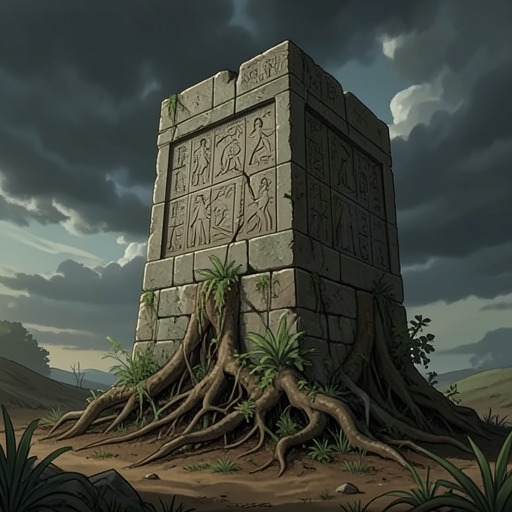
Rock Falls, Everyone DiesMt Tartus is both the stone’s original landscape and the most persistent physical emblem of its unfinished journey. The mountain gives the stone a place from which to roll, wait, fight, and measure time; much later, when the stone has become a planet, it reconstructs Mt Tartus from shattered terrain in an effort to make the old quest valid again. The attempt ends not in completion but in a system error, turning the mountain into a monument to memory, scale, and the limits imposed by rules that even planetary power cannot simply erase.
Definition and Early Setting
Mt Tartus is the mountain associated with the Tutorial Quest: Roll out, the formative objective that directs the stone toward movement and descent. Its slopes are not merely a backdrop. They are the terrain through which the stone first understands motion, duration, and the difference between a brief action and an age of waiting. The mountain anchors the stone’s experience before the narrative expands beyond ordinary geography, making it the original measure against which later discoveries are judged.
The stone’s connection to Mt Tartus also gives the place a special temporal quality. It knows the mountain from repeated and radically unequal experiences: it can roll down the slopes in a brief moment, yet it can also remain there for hundreds of years. This contrast makes the mountain a place where the stone’s nature as a patient, nearly immobile being becomes inseparable from its quest. The same landscape accommodates both instantaneous descent and geological stillness.
A Landscape of Memory
As the stone’s awareness grows, its understanding of the world changes from local and limited to planetary and cosmic. It eventually recognizes that the world beneath it is itself a very large rock, and that everything around it belongs to a continuum of stone distinguished mainly by scale and power. Against this widening cosmology, Mt Tartus becomes paradoxical: physically small in relation to a planet or a star, but disproportionately important because it contains the stone’s remembered beginning.
The mountain therefore survives as an inner geography even after the stone has learned to perceive worlds from beyond their surface. Its significance does not depend on size. The stone’s later realization that all things are fundamentally rocks makes Mt Tartus part of a much larger material order, but it does not dissolve the mountain’s singular role. It remains the particular rock-form tied to the first instruction that gave the stone’s existence a direction.
Reconstruction After Planetary Transformation
After accepting advancement to level 12 as a Planet and entering the planetary fusion process, the stone becomes vastly larger and gains abilities appropriate to its new scale. Yet its growth does not eliminate its attachment to the earlier mountain. In the aftermath of rage and self-shattering, it uses Create Mountain and Sculpt Earth to shape a new mountain from the broken ground. The act is deliberate reconstruction rather than accidental geological change: the stone draws on its memory of having flown over Mt Tartus, rolled down its slopes, and waited upon it across centuries.
The recreated mountain is an attempt to restore a lost relationship between place and quest. The stone assigns the mountain a name, linking it to the old objective and waiting for the system to recognize the connection. This naming is an exercise of planetary authority, but it is also an admission that power alone is insufficient. The stone can sculpt the terrain and impose a name upon it, yet it still requires the system to accept that the recreated site satisfies the original condition.
The Quest Error
The system responds by displaying the Tutorial Quest: Roll out, with the recreated location at an altitude of zero. Instead of resolving the quest, however, it reports that the stone is Mt Tartus but that the distance is invalid. The quest remains unresolved because the destination falls just outside the stone’s reach. The result is especially severe because the stone has reproduced the mountain closely enough to invoke the quest, but not closely enough to satisfy the rule governing completion.
This failure changes Mt Tartus from a place of beginning into a site of frustrated recognition. The system acknowledges the name and the connection while rejecting the spatial conditions. The mountain is therefore simultaneously present and inaccessible: recovered as terrain, recognized as identity, but still unable to deliver the promised resolution. Its distance is not simply a measurement; it is the remaining gap between the stone’s remembered past and its transformed planetary existence.
Narrative Significance
Mt Tartus represents continuity across the story’s successive changes of scale. The stone passes from battlefield object to dungeon intruder, cultivator, cosmic traveler, and Planet, while the mountain remains the fixed reference point against which those transformations can be understood. Even when the stone sees planets, stars, and asteroids as rocks of different magnitude, its most meaningful landscape remains the mountain connected to its first rolling path.
The mountain also exposes the tension between self-determination and inherited rules. The stone eventually realizes that it must proceed by its own power rather than allowing others to carry it for their agendas, yet its attempt to reclaim Mt Tartus still depends on a system-created quest and its hidden conditions. The reconstructed mountain proves that memory can guide creation without guaranteeing restoration. In the later cycle of the story, the old stone transfers the quest forward to a young hero, suggesting that Mt Tartus cannot be reached by force of recollection alone. Its unresolved status becomes part of the inheritance: the mountain is recreated, the quest is preserved, and the next traveler is left to discover what the original stone could not complete.